
Insight
When Hospitality Technology Finally Starts Talking to Each Other
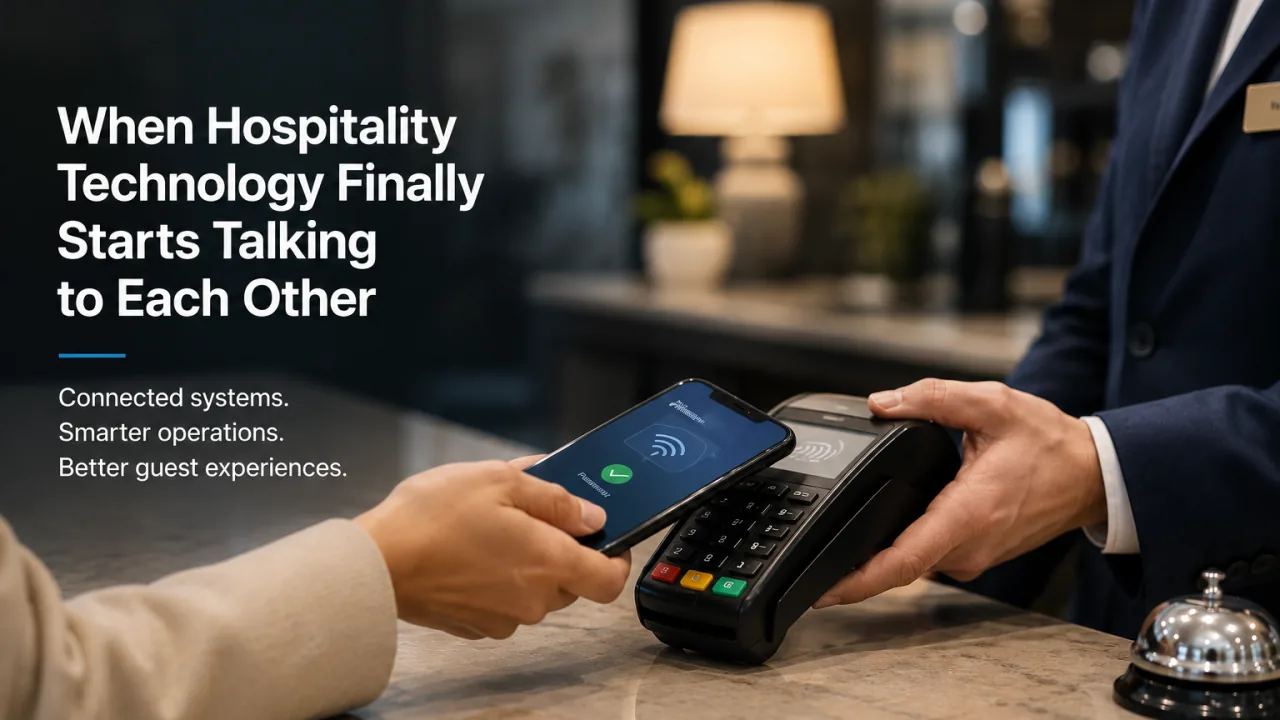
Operators running property management systems, POS platforms, payment gateways, loyalty programs and reporting tools that don't talk to each other lose time to manual reconciliation and fragmented reporting — even as the industry runs more technology than ever.
While each solution delivers value individually, many businesses still face the same challenge: their technology does not communicate effectively. Information becomes fragmented, teams spend time moving data manually, and operators lose visibility across their business.
The problem is not the technology itself. The problem is disconnected technology.
The Cost of Disconnected Systems
Many hospitality businesses operate multiple platforms that work independently from one another. Payments may exist in one system, customer information in another, and operational data somewhere else entirely.
As businesses grow, these disconnected systems create additional complexity. Staff spend valuable time reconciling data, generating reports from multiple sources, or manually updating information between platforms.
Common challenges include:
- Customer information stored in multiple systems.
- Manual reconciliation between payments and operations.
- Limited visibility across locations and departments.
- Inconsistent reporting and duplicated data.
- Increased operational costs and human errors.
Instead of simplifying operations, technology can sometimes create additional work.
The Value of Seamless Integration
When systems communicate properly, information flows automatically across the business. Payments, reservations, customer profiles, loyalty programs, and operational data become part of a connected ecosystem.
This provides several benefits for operators:
- Less manual work for teams.
- More accurate reporting.
- Faster access to operational data.
- Better decision-making.
- Reduced errors and duplicated processes.
- Improved efficiency across departments.
Rather than managing multiple disconnected systems, businesses gain a single operational view of their environment. Payment integration that connects PMS, POS and payments is the layer that makes this possible.
Creating One Guest Experience
Guests never think about the systems operating behind the scenes. They simply expect everything to work smoothly.
A great guest experience often depends on technology that remains invisible:
- Fast and secure payments.
- Personalized service.
- Accurate orders and transactions.
- Consistent experiences across locations.
- Staff having the right information at the right time.
When systems work together, employees can focus on hospitality rather than managing technology.
Owning Data and Customer Relationships
Data has become one of the most valuable assets in hospitality. However, when information is spread across multiple platforms, businesses lose visibility into customer behavior and operational performance.
Connected systems help operators:
- Understand customer preferences.
- Build stronger loyalty programs.
- Access real-time business insights.
- Make data-driven decisions.
- Maintain ownership of customer relationships.
The business remains in control of its data, its operations, and its customer experience.
Looking Ahead
The future of hospitality technology is not about adding more systems. It is about connecting the systems businesses already use.
When payment solutions, enterprise platforms, hospitality applications, and operational tools work together, operators gain visibility, employees become more efficient, and guests enjoy a better experience.
Seamless integrations and connected systems create more than operational efficiency — they create one unified guest experience, where businesses own their data, technology works together, and hospitality teams can focus on what matters most: their guests.
To see how payments connect PMS, POS and back-office systems in practice, visit Juno Hospitality Suite or explore PMS & POS systems integrations.
Related on 934: Juno Hospitality Suite · PMS & POS systems integrations
- Integrations
- Hospitality
- Payments